
Audio Is the Key Feature When Selecting an Intercom
In today’s complex and ever-changing world of security and risk management, effective communication is paramount. Whether you’re managing a multi-unit residential building, a commercial facility or an industrial site, an intercom and door entry communication system is more than just a convenience – it’s a critical communication tool for your staff, visitors and vendors.
The good news is that there are many available IP intercoms on the market.But how do you choose the communication system that’s best for your facility? There are several considerations, to include:
Can it be positioned inside or outside?
Is the intercom built well, to ensure a long product life?
Can it be easily disassembled to replace core components for upgrades and repairs?
Are the product design and materials used aligned with the aesthetics of modern buildings?
Can it be integrated with access control and IP camera systems to increase security?
Does it have energy efficiency features to minimize power usage in line with sustainability objectives?
Does it offer visual and aural feedback to support accessibility for all users?
Can the intercom’s audio quality overcome high-noise environments and allow users to clearly hear, be heard and be understood?
That last question is the most important, and it should be your first question to ask. If the audio quality cannot meet the demands of the environment, then security, convenience and user experience quickly disappear.
While features like video integration, mobile access or cloud connectivity often steal the spotlight with an intercom and communications system, the single most important feature to prioritize is audio quality. Here’s why.
1. Communication Starts with Clarity
The primary function of an intercom system is voice communication. If the person on the other end can't hear you clearly or you can't hear them, then the system fails at its most basic task. Crisp, reliable audio ensures instructions are understood, visitors are identified and responses are timely. Poor audio quality can lead to:
Misunderstood instructions
Delays in response time
Frustrated users
Increased security risks
In environments where quick decision-making is essential – like hospitals, warehouses or security checkpoints – muddled audio isn't just inconvenient; it can be dangerous.
2. Security Depends on Accurate Verification
Many intercom systems are used for verifying visitors before granting access. If the audio is garbled or inconsistent, it becomes nearly impossible to distinguish someone’s voice or catch signs of distress or deception. Clear audio allows security teams to:
Detect tone, urgency or emotion
Identify speakers with greater confidence
Confirm names, reasons for visits or security codes without repetition
This level of assurance is especially critical in places with restricted access or high-value assets.
3. Noisy Environments Demand Better Sound
In busy or industrial areas — such as construction sites, factories, large campuses and office buildings – background noise is a given. If someone is standing outside your facility and trying to gain access, you should assume that there will always be a situation (traffic, weather and even the person’s manner or language spoken) that will create “noise.” Only crystal-clear audio with noise cancellation or advanced filtering features can cut through environmental sounds and deliver clear and intelligible speech.
Some intercoms often pick up more ambient noise than voice, making communication frustrating and inefficient. Investing in superior audio components ensures the intercom performs consistently even in challenging settings.
4. User Experience Matters
No one wants to repeat themselves over and over or deal with dropped sentences and static. These annoyances not only degrade user experience but also reduce trust in the intercom’s reliability. On the other hand, a system with crystal clear audio is:
Easier to use for all age groups
More inclusive for people with hearing difficulties
More likely to be used effectively on a regular basis
Clear communication boosts user satisfaction and system adoption across the board.
5. Audio Quality Reflects Brand Professionalism
In commercial and corporate environments, an intercom system is often a visitor's first point of contact. A garbled or crackling intercom can project a negative image – suggesting outdated technology or poor facility management.
In contrast, a clear, responsive system reflects professionalism, attention to detail and a commitment to high standards. It signals to visitors, clients and tenants that the organization values their experience.
What to Look for in an Intercom that Delivers Superior Audio
Achieving super audio requires intelligent software features that adapt to the nearby environment. They include acoustic echo cancellation, which enables both people to talk at the same time, even at high volumes (95dB). Automatic gain control will take a voice that is too loud or too weak and level it out to an undistorted and clear signal. Automatic volume control will detect the noise level in the area and automatically adjust the volume to ensure voices are easily heard. Noise cancellation reduces the background noise and means that the user does not need to speak directly into the microphone to be heard.
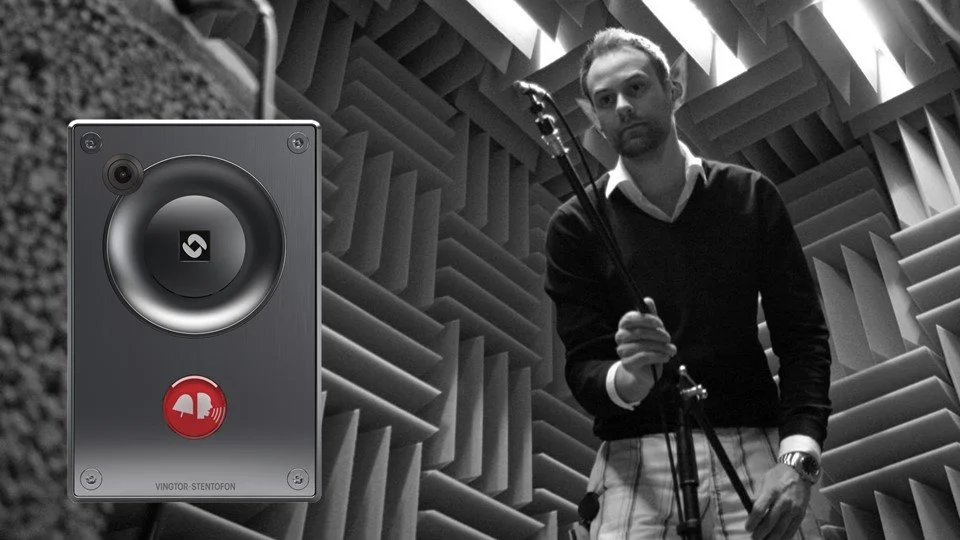
For the very best audio quality, physical design matters, too. A traditional intercom speaker design will include two overlapping stainless-steel plates, which will trap some of the sound waves between them and create distortion. Instead, the speaker grille should incorporate an anechoic, circular design where there’s no reflection of sound waves as they pass through the station’s faceplate. The result is crystal clear audio at any volume.
The exterior should also feature a solid aluminum, die-cast frame and an acoustically transparent poke screen so that someone cannot tamper with it.
When the solution features built-in video, the camera should incorporate a wide-angle lens and strong low-light performance to deliver excellent image quality, day or night. A wide Field of View will capture more of the area around the intercom station, and a 30-per-second frame rate provides a natural look for any movement caught on the camera.
Last, the solution should employ a fast data processor, which translates into stability, uptime and a long product lifetime. That efficiency in data processing also provides the opportunity for additional product integrations and future development.
Achieving “Loud and Clear”
While it’s tempting to prioritize flashy features, the heart of any intercom and communication system is its ability to clearly and reliably transmit speech and sound. Audio quality impacts safety, security, usability and even perception. Without it, all other features become secondary.
It is meaningless to purchase a communications system if the audible announcements and messages being delivered can’t clearly be heard or understood. Therefore, it’s important to select a solution that offers audio and voice technology that allows people to hear, be heard and be understood, in every situation.
Written by Diane Ritchey
Head of Marketing and Communications, Safety & Security, Zenitel Americas